
Understanding Your Hair Between 18–30
A Complete Hair Care Guide for Healthy, Strong Hair
Your hair between the ages of 18 and 30 is at its strongest biological potential.
This is the phase where hair grows faster, recovers quickly, and tolerates stress better than any other stage of life.
Yet, ironically, this is also the age when most long-term hair damage begins.
Why?
Because problems don’t show immediately.
And when damage is invisible, habits become careless.
This guide explains how hair behaves in your 18–30s, what silently weakens it, and how to protect it—so your hair remains strong not just now, but in your 30s, 40s, and beyond.
Why the 18–30 Age Group Is Crucial for Hair Health
During this phase:
-
Hair growth cycles are fast
-
Scalp oil production is active
-
Hair follicles recover quickly
-
Minor damage doesn’t show immediately
This creates a false sense of confidence.
Many people assume:
“My hair is strong, so I can do anything.”
But hair has memory.
What you repeatedly do now becomes the baseline quality of your hair later.
Your 18–30s are not for correcting hair problems.
They are for preventing future ones.
The Biggest Hair Mistake People Make in Their 20s
The most common mistake is overusing hair without maintaining the scalp.
This includes:
-
Excessive heat styling
-
Frequent chemical treatments
-
Ignoring oiling and conditioning
-
Irregular washing routines
-
Treating hair care as optional
Hair may still look fine—for now.
But the foundation weakens silently.
Most people realise this only in their 30s, when hair fall, thinning, dryness, or texture changes suddenly appear.
Step 1: Pre-Wash Scalp Oiling (Support, Not Overload)

Oiling is not about making hair greasy.
It is about preparing the scalp for cleansing.
Why scalp oiling matters
-
Maintains healthy blood circulation
-
Prevents shampoo-induced dryness
-
Balances natural oil production
-
Reduces stress-related hair shedding
How often should you oil?
-
Normal scalp: once a week
-
Dry scalp: twice a week
-
Oily scalp: once a week only
More oil does not mean faster growth.
Correct way to oil
-
Use only ½ to 1 teaspoon
-
Apply on scalp and roots
-
Massage gently with fingertips for 2–3 minutes
-
Leave for 30–60 minutes
-
Wash off
Overnight oiling is not needed unless the scalp is extremely dry.
Step 2: Hair Washing – Clean Scalp, Strong Hair
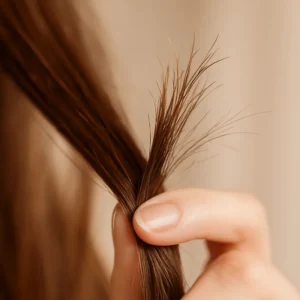
A clean scalp is essential for healthy hair growth.
How often should you wash?
-
Normal scalp: 2–3 times a week
-
Oily scalp: alternate days
-
Dry scalp: twice a week
Consistency matters more than frequency.
Correct shampoo method
-
Dilute shampoo with water
-
Apply only on the scalp
-
Massage gently
-
Let the foam cleanse the lengths naturally
Avoid:
-
Scrubbing hair lengths
-
Very hot water
-
Rough towel drying
Conditioner Is Not Optional
Many people skip conditioner in their 20s, thinking it’s unnecessary.
That’s a mistake.
Conditioner:
-
Protects the hair fibre
-
Reduces friction damage
-
Prevents dryness and breakage
How to use conditioner
-
Apply from mid-length to ends
-
Leave for 1–2 minutes
-
Rinse thoroughly
Conditioner does not cause hair fall when used correctly.
Step 3: Post-Wash Leave-In Care
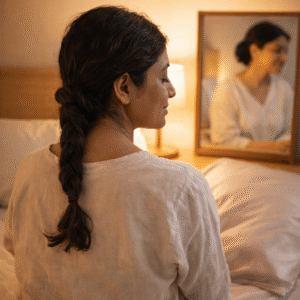
Daily serums are often overused.
Most commercial serums:
-
Are silicone-based
-
Give instant smoothness
-
Coat the hair externally
-
Cause long-term dryness
A better approach: minimal leave-in nourishment
-
Hair should be damp
-
Use 1–2 drops of a light natural oil
-
Apply only to mid-length and ends
-
Avoid the scalp
This controls frizz, seals moisture, and prevents breakage—without buildup.
Internal Support: Hair Reflects Lifestyle
Hair is not separate from the body.
Daily internal support should include:
-
Adequate protein (dal, curd, eggs, paneer, legumes)
-
Fruits and vegetables
-
Healthy fats (nuts, seeds)
-
Sufficient water intake
Avoid:
-
Crash dieting
-
Overuse of supplements without need
Hair quality always reflects internal balance.
What You Can Expect When You Care for Hair Correctly in Your 20s
With a simple, consistent routine, you’ll notice:
-
Stronger, more manageable hair
-
Reduced breakage and frizz
-
Better texture and shine
-
Fewer hair problems later in life
The goal is not dramatic results now.
The goal is effortless hair health later.
Final Thought
Between 18 and 30, hair problems are rarely genetic.
They are habit-based.
Protect your hair in this phase,
and it will protect you for decades to come.
Leave a Reply