
Liquorice (Mulethi): The Ancient Root That Restores Skin, Hair, and Inner Balance
In a world obsessed with instant glow, strong actives, and quick fixes, skin is often treated like a surface problem to correct rather than a system to understand.
Liquorice does not follow this trend.
It does not bleach.
It does not rush.
It does not force results.
Instead, it restores balance. And when balance returns, glow follows naturally.
Used for centuries in Ayurveda, Unani, and traditional medicine, liquorice is now supported by modern research for its ability to calm inflammation, reduce pigmentation, support scalp health, and help the body respond better to stress.
This blog explores why liquorice works, how science validates ancient wisdom, and how to integrate it gently into daily self-care the Yeka way.
Understanding Skin Darkness: It Is Not Dirt, It Is Imbalance

One of the most misunderstood truths about skin health is this.
Skin darkening is rarely caused by dirt.
It is most often caused by inflammation.
Common causes of pigmentation, tan, and dullness include:
• Chronic sun exposure
• Heat trapped in the skin
• Hormonal fluctuations
• Stress and cortisol imbalance
• Overuse of harsh products
• A damaged skin barrier
When skin is inflamed, the body produces more melanin as a protective response. This is why aggressive scrubs, bleaching agents, and overuse of actives often worsen pigmentation over time.
Ayurveda describes this as excess Pitta, or heat and irritation within the system.
The solution is not to fight melanin.
The solution is to calm the inflammation behind it.
This is where liquorice begins its work.
The Science Behind Liquorice and Pigmentation
Modern dermatological research highlights a powerful compound in liquorice called glabridin.
Glabridin has been shown to:
• Inhibit tyrosinase, the enzyme responsible for excess melanin production
• Reduce UV-induced pigmentation
• Calm oxidative stress in skin cells
• Support even skin tone without damaging the skin barrier
Unlike chemical bleaching agents, glabridin does not destroy melanin-producing cells. It regulates their overactivity.
This matters because it means:
• No rebound pigmentation
• No thinning of the skin
• Safe long-term use
• Suitable for sensitive and reactive skin
Glow from liquorice comes from regulation, not aggression.
Liquorice as a Powerful Anti-Inflammatory Herb
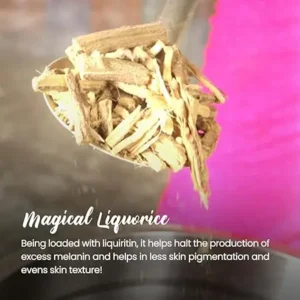
Inflammation sits at the root of many skin concerns, including:
• Acne
• Redness
• Sensitivity
• Post-acne marks
• Premature aging
Liquorice contains flavonoids and glycyrrhizin, compounds known for their soothing and anti-inflammatory properties.
Research shows liquorice can:
• Calm redness comparable to mild corticosteroids without side effects
• Reduce irritation in acne-prone skin
• Support healing of compromised skin barriers
• Soothe skin aggravated by heat and stress
This makes liquorice especially helpful for:
• Sensitive skin
• Acne-prone skin
• Post-inflammatory pigmentation
• Over-treated or over-exfoliated skin
In simple terms, liquorice tells the skin it is safe again.
Hair and Scalp Health: Calm Scalp, Stronger Hair
Hair fall rarely begins in the hair itself.
It begins at the scalp.
Common scalp issues today include:
• Itching
• Inflammation
• Sensitivity
• Stress-related hair fall
• Weak roots due to poor circulation
Liquorice supports scalp health by:
• Reducing inflammation
• Soothing irritation and itchiness
• Supporting healthier follicles
• Creating a balanced environment for growth
Ayurveda teaches that hair grows best in calm, nourished conditions, not dryness or irritation.
A peaceful scalp allows hair to grow stronger over time.
The Stress–Skin–Hair Connection

One of liquorice’s most overlooked benefits is its adaptogenic nature.
Adaptogens help the body respond to stress gently instead of reacting aggressively.
Chronic stress increases cortisol, which:
• Triggers inflammation
• Worsens acne
• Deepens pigmentation
• Disrupts hair growth cycles
• Weakens the skin barrier
Liquorice supports the adrenal system and helps regulate stress responses. This indirectly improves:
• Skin clarity
• Hair fall patterns
• Overall glow
When the nervous system softens, skin and hair follow.
This is why Yeka does not separate skincare from emotional well-being.
Safety and Trust: Why Liquorice Is Time-Tested Care
Liquorice is not a trend ingredient.
It is heritage care.
• Used for thousands of years in Ayurveda and Unani medicine
• Applied externally and consumed internally under guidance
• Gentle enough for regular rituals
• Supported by both traditional wisdom and modern science
Unlike aggressive actives that rise and fall with trends, liquorice has endured because it works with the body, not against it.
This is slow beauty.
Rooted beauty.
Conscious beauty.
How to Integrate Liquorice Into Daily Life
Liquorice does not require complicated routines.
It works best with consistency and calm.
Simple ways to integrate liquorice include:
• Soothing face packs
• Gentle oils or serums
• Calming scalp treatments
• Minimalist daily rituals
The key is regularity, not intensity.
Small daily rituals create deeper healing than occasional extremes.
Yeka’s Philosophy and Liquorice
At Yeka, glow is not chased.
It is restored.
We believe in:
• Respecting the body’s intelligence
• Healing from the root
• Balancing skin, hair, and nervous system
• Honouring ancient wisdom through modern understanding
Liquorice reflects everything Yeka stands for.
Gentle yet effective
Scientific yet soulful
Ancient yet relevant
Healing rather than hiding symptoms
Final Reflection
Liquorice does not chase glow.
It restores balance.
When inflammation calms,
when stress softens,
when skin feels safe again,
glow emerges naturally.
Liquorice is not a shortcut.
It is a companion in healing.
And in a world rushing toward faster results, choosing balance may be the most powerful act of self-care.
Leave a Reply