
Understanding Your Hair Between 30–40
A Complete Hair Care Guide for Healthy, Strong Hair
Your 30s are a transition phase for hair.
Not a decline.
Not damage.
This is the phase where hair begins to respond more honestly to your lifestyle, stress levels, sleep quality, and care habits.
Many people panic when they notice hair fall, dryness, or texture changes in their 30s. The truth is simpler and reassuring.
Hair between 30–40 is still strong. It just needs balance, not force.
What Actually Changes in Hair Between 30–40
Hair does not suddenly become weak after 30.
What changes is recovery speed.
Here is what most people start noticing:
• Stress reflects faster on hair
• Sleep quality directly affects hair fall
• Hormonal shifts subtly begin
• Heat and styling damage becomes visible
• Hair takes longer to bounce back
The biggest mistake at this stage is over-treating instead of understanding.
The Good News Most People Don’t Know
Most hair problems between 30–40 are preventable and reversible.
Hair fall, dryness, thinning, and dullness at this age are usually caused by:
• Wrong washing frequency
• Heavy oiling habits
• Overuse of serums
• Excess heat styling
• Inconsistent routines
Correct the routine early, and hair stabilises beautifully.
Step 1: Pre-Wash Scalp Oiling
Oiling is not about making hair greasy.
It is about supporting the scalp.
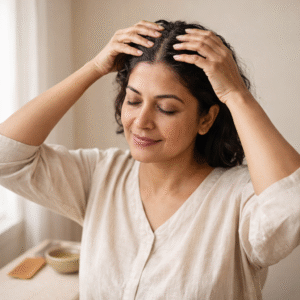
Why scalp oiling matters in your 30s
• Reduces stress-related hair fall
• Improves blood circulation
• Prevents wash-induced dryness
• Supports a healthy hair growth cycle
How often should you oil
• Oily scalp: once a week
• Dry scalp: twice a week
More oiling does not mean more growth.
The Correct Way to Oil
• Quantity: one teaspoon only
• Apply on scalp and roots, not lengths
• Massage gently with fingertips for 3–5 minutes
• Leave for 30–90 minutes
• Wash off
Avoid overnight oiling unless the scalp is extremely dry.
Step 2: Washing Routine

There is no single rule for everyone.
Ideal washing frequency
• Normal scalp: 2–3 times per week
• Oily scalp: alternate days
• Dry scalp: twice a week
Hair loves predictability.
Irregular washing confuses the scalp more than frequent washing.
How to Shampoo the Right Way
Shampoo is meant for the scalp, not the hair length.
• Dilute shampoo with water
• Apply only on the scalp
• Massage gently
• Let the foam cleanse the lengths while rinsing
Avoid hot water and rough scrubbing.
Conditioner Is Not Optional After 30
From your 30s onwards, conditioner becomes essential.
• Apply only from mid-length to ends
• Leave for two minutes
• Rinse well
Conditioner helps:
• Reduce breakage
• Prevent dryness
• Protect the hair fibre
Skipping conditioner often causes more hair fall than shampoo.
Step 3: Post-Wash Leave-In Care

Daily serums are not necessary.
Instead:
• Use 1–2 drops of a light natural oil
• Apply on damp hair
• Only on mid-length and ends
This supports:
• Frizz control
• Moisture sealing
• Heat and pollution protection
Less product results in healthier hair.
Why Daily Silicone Serums Are Discouraged
Most commercial serums:
• Sit on hair instead of nourishing
• Block moisture entry
• Increase dryness over time
Natural oils:
• Absorb into hair
• Nourish internally
• Improve texture long-term
Serums are fine occasionally, not daily.
Hair Type–Wise Care Between 30–40
Curly or Wavy Hair
• Condition every wash
• Use leave-in oil
• Avoid dry brushing
Straight but Dry Hair
• Oil once or twice weekly
• Protect ends consistently
Oily Scalp With Thin Hair
• Oil once weekly
• Wash on alternate days
Heat or Colour-Damaged Hair
• Reduce heat
• Focus on routine, not quick fixes
• Expect gradual recovery
Internal Support Matters More Than Products
Hair health reflects daily nourishment.
Support hair with:
• Protein such as dal, curd, eggs, paneer
• Healthy fats like nuts, seeds, ghee
• Fruits and vegetables
• Adequate water intake
Hair supplements should be limited to one per day. More is unnecessary.
Daily and Night Habits That Protect Hair
• Keep hair in a loose braid or bun
• Use cotton or silk pillowcases
• Never sleep with wet hair
• Avoid tight hairstyles
Expected timeline
• 2–3 weeks: reduced hair fall
• 4–6 weeks: improved texture
• 2–3 months: stronger, healthier hair
Final Truth About Hair Between 30–40
Hair in your 30s does not need aggressive treatments.
It needs understanding, consistency, and gentleness.
Balance today prevents damage tomorrow.
If you respect this transition phase, your hair will not just survive your 30s.
It will thrive through them.
If you want next, I can also:
Leave a Reply