
How Over-Caring Can Create Sensitive Skin in Children
Most parents who take extra care of their child’s skin do so out of love.
They want to:
- Prevent dryness
- Avoid rashes
- Keep the skin soft and comfortable
So they cleanse regularly, moisturise daily, and apply products at the first sign of change.
But there is a truth that is rarely discussed in skincare conversations:
In children, too much care can quietly make the skin more sensitive over time.
This article explains how over-caring affects children’s skin, why sensitivity is often created rather than inherited, and how stepping back slightly can help the skin regain its natural strength.
Kids Skin Is Designed to Learn Through Experience

Children’s skin is not meant to be constantly managed.
It is naturally designed to:
- Adapt to weather conditions
- Adjust to water exposure
- Learn natural oil regulation
- Build tolerance gradually
Just like the immune system strengthens through exposure, the skin barrier also becomes stronger when it is allowed to function naturally.
Healthy skin development requires minimal support, not constant replacement.
What “Over-Caring” Actually Looks Like
Over-caring does not mean neglect or poor hygiene.
In many homes, it simply looks like:
- Daily soap use even when there is no visible dirt
- Moisturising out of habit rather than need
- Applying multiple products “just to be safe”
- Reacting immediately to every small skin change
These actions feel responsible and protective.
However, they can unintentionally interrupt the skin’s natural learning process.
How Over-Care Weakens the Skin Barrier
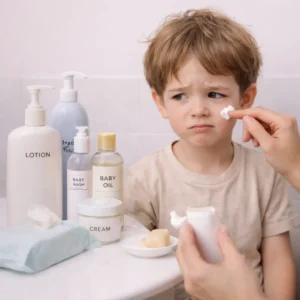
When children’s skin is repeatedly:
- Cleansed
- Stripped of natural oils
- Re-coated with external products
The skin slowly begins to depend on those external supports.
Over time:
- Natural oil production reduces
- Barrier recovery slows down
- Skin becomes reactive when products are not applied
This is how dependency gradually turns into sensitivity.
Why Sensitive Skin Is Often Created, Not Inborn
Many parents believe:
“My child just has sensitive skin.”
While genetics can influence skin behaviour, most childhood sensitivity develops due to environmental factors and daily habits.
When the skin experiences repeated interference, it slowly learns to:
- Expect constant external support
- React strongly to environmental changes
- Struggle when products are skipped
This means sensitivity is often a learned skin response, not a permanent condition.
The Silent Cycle of Over-Care
A common cycle often develops without parents realizing it:
- Skin is cleansed frequently
- Skin begins to feel dry or tight
- Moisturiser is applied
- Skin adapts to the product
- Product is skipped one day
- Skin reacts more strongly than before
This reinforces the belief:
“My child needs constant skincare.”
But in many cases, the skin has simply been trained to depend on it.
How Stepping Back Helps Skin Reset

When parents slowly reduce:
- Unnecessary cleansing
- Habit-based moisturising
- Multiple product layers
The skin is given space to:
- Restore its natural barrier
- Relearn oil balance
- Become more tolerant and resilient
This reset does not happen overnight.
But over time, the skin often becomes calmer and stronger.
What “Enough Care” Really Means for Kids
Healthy care for children’s skin does not require complicated routines.
Instead, it means:
- Cleaning the skin only when necessary
- Supporting dryness only when it appears
- Observing before reacting
- Allowing the skin to self-correct
This approach builds confidence in the skin, not dependence on products.
What Parents Should Remember
Sensitive skin in children is not always something they are born with.
It can develop when:
- Skin is constantly managed
- Natural processes are replaced by products
- Fear drives skincare decisions
A calm and minimal approach often allows the skin to develop natural resilience.
Final Takeaway
More care does not always mean better care.
For children’s skin:
- Less interference builds stronger barriers
- Simplicity supports natural balance
- Patience prevents long-term sensitivity
When parents step back slightly, children’s skin often steps forward — becoming stronger, calmer, and more resilient.
Leave a Reply